Wet Scrubbers
Capture sub-micron dust with Venturi Wet Scrubbers
The Nederman MikroPul Venturi Wet Scrubber accelerates dirty gas through an adjustable throat, where it collides with scrubbing liquid to trap particles other collectors miss — even on hot, humid, high-concentration streams.
How it works
The scrubbing cycle, from entry to clean gas
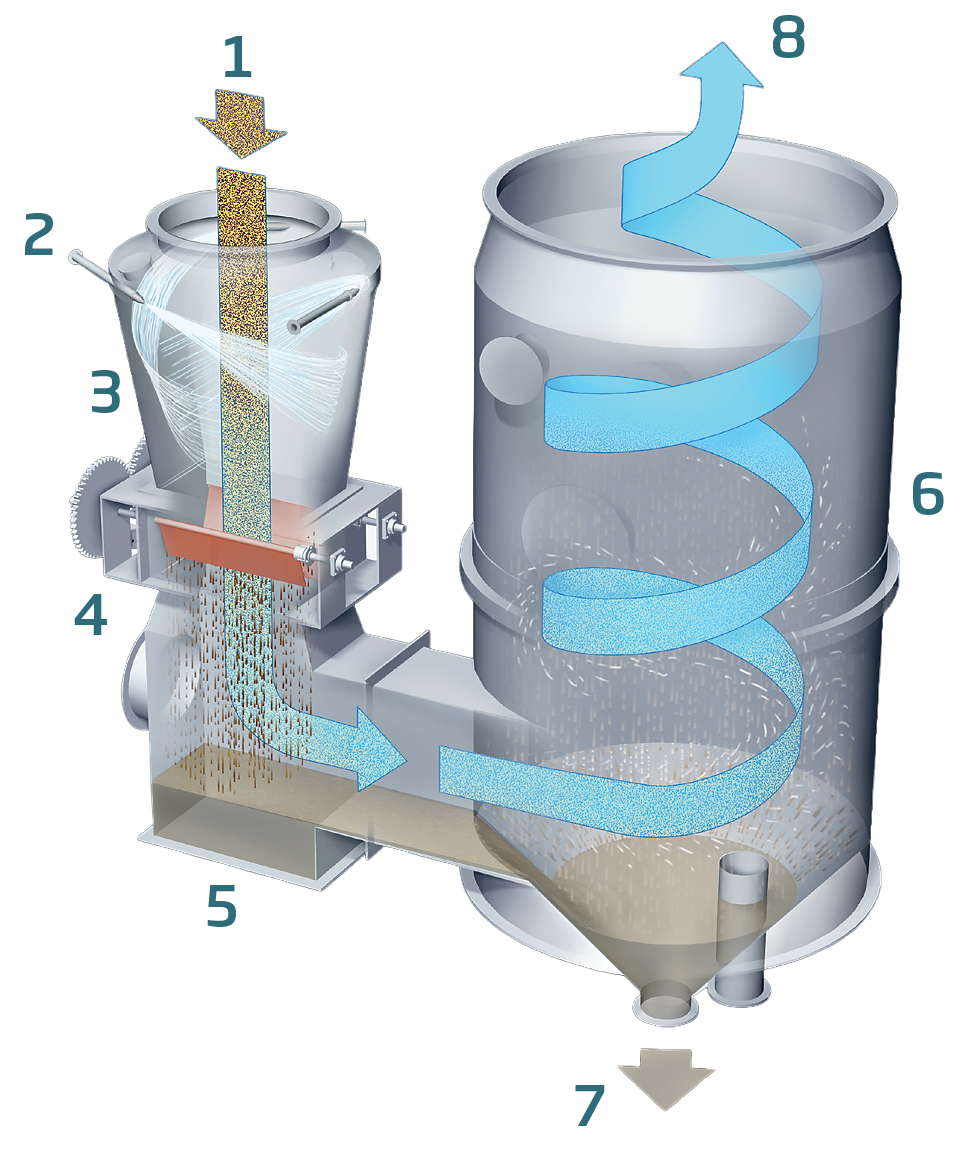
A venturi scrubber captures particulate by accelerating dirty gas through a narrowing throat, where it collides with scrubbing liquid. Follow the eight stages of a single pass.
Gas enters
Dust-laden gas enters the wet-approach venturi.
Meets liquid
Gas instantly contacts scrubbing liquid introduced tangentially.
Swirls down
The stream swirls along the venturi's converging walls.
Collides at the throat
At the adjustable throat, streams collide and liquid breaks into droplets that trap dust.
Enters separator
The mixture passes a flooded elbow into the entrainment separator via a tangential inlet.
Centrifugal removal
Centrifugal action pulls heavy wetted particles out of the gas stream.
Discharges
The dust/liquid mixture drains from the separator bottom.
Clean gas exits
Cleaned gas leaves through the top of the separator.
Why should you choose the Venturi Scrubber
Venturi Wet
Dust Scrubbers
Nederman MikroPul’s flexible designs are well suited to solving problems across multiple industries. These include mining, chemicals, food, pulp & paper, explosive dust and metals applications, such as HCl and particulate removal in Aluminum refining. MikroPul venturi scrubbers are designed for long working life with minimal maintenance. Our experienced engineers deliver superior yet simple venturi scrubber designs in appropriate materials, with optimized features to suit your specific application.
Nederman MikroPul venturi scrubbers are valuable in processes needing high particulate removal efficiency, typically greater than 99.9% for sub-micron particles. They excel in high inlet gas temperatures, high dust/particle loading and high percentage of solids in the liquid recirculation loop.
efficient on sub-micron particles
handles hot gas streams
few moving parts, long life
designs built to your application
The design
A wet-approach venturi and a liquid entrainment separator
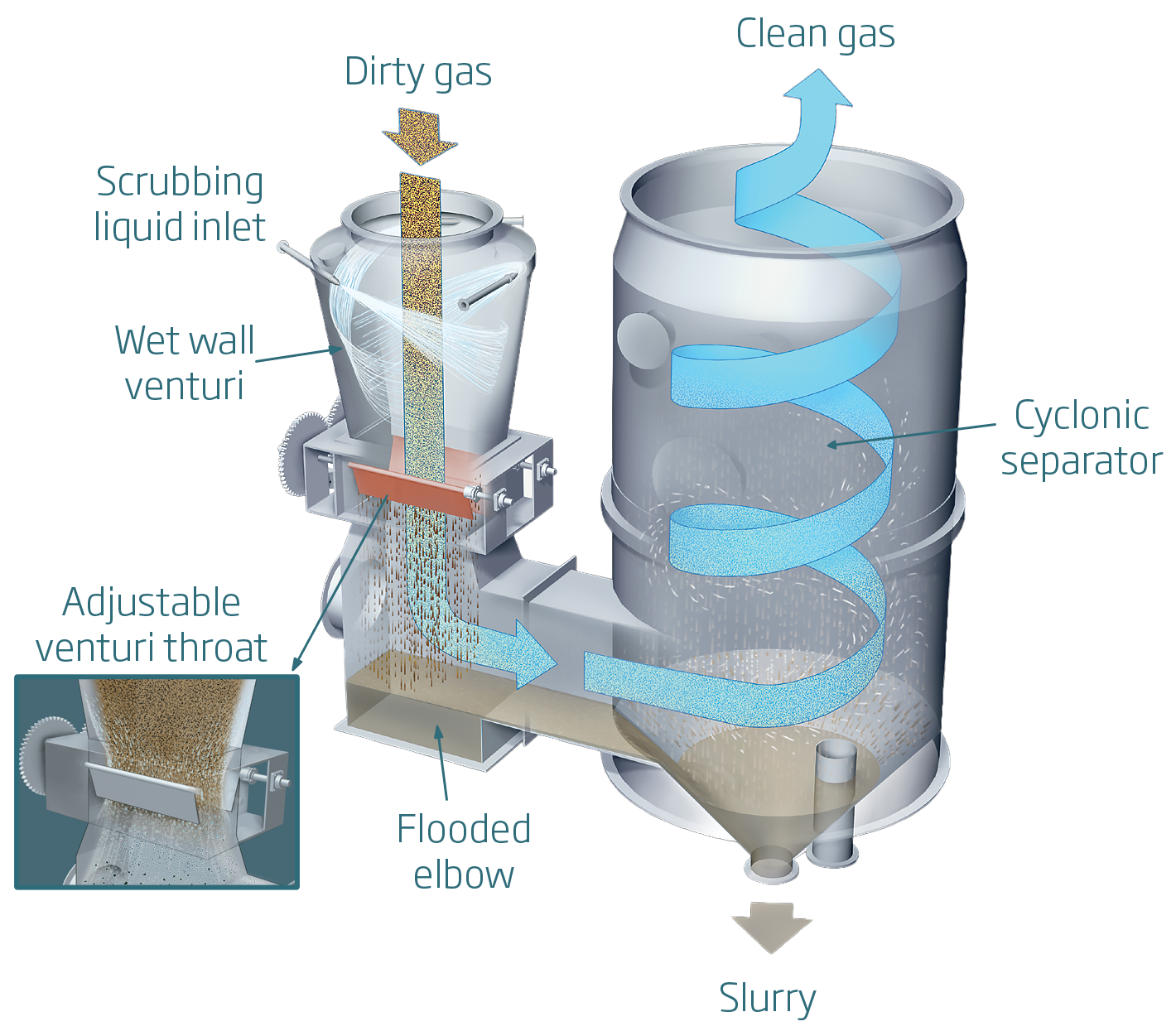
The Nederman MikroPul Venturi Scrubber pairs a “wet approach” venturi with a liquid entrainment separator. Dust-laden gases enter the venturi and immediately meet the tangentially introduced scrubbing liquid swirling down the converging walls.
At the adjustable throat, the gas and liquid streams collide and the liquid breaks into droplets that trap dust particles. The mixture passes through a flooded elbow into the entrainment separator through a tangential inlet, where a cyclonic separator removes the heavy wetted particles. When very large-diameter separation is required, a chevron-type mist eliminator baffle separates the liquid instead.
The dust/liquid mixture discharges from the separator bottom drain and cleaned gas leaves through the top. Because the design uses open pipe liquid inlets with no spray nozzles, maintenance stays minimal.
Technology Overview
Advantages of venturi wet scrubbers
Compared with filters and other dust collection equipment, venturi scrubbers stay compact while handling gas streams that are high-temperature, high-humidity or particle-laden.
| Advantage | |
|---|---|
| Equipment size | Smaller footprint than comparable dry collection equipment. |
| Materials | Wide choice of construction options to suit the process chemistry. |
| Maintenance | Very few moving parts; open pipe inlets with no spray nozzles. |
| Cleaning | Continuous blow-down of scrubbing liquid with freshwater makeup reduces downtime. |
| Performance | Handles gas with high humidity and high temperature. |
| Particulate | High concentrations; efficiency above 99.9% for PM2.5. |
| Scrubbing liquid | NaOH, H₂SO₄ or reagents customized to suit the chemistry. |
| Options | CIP nozzles, controls and multi-venturi configurations. |
Configurations
Three basic designs
From a single-stage venturi to multi-stage and multi-venturi rod-deck designs, each is matched to the removal level, pressure drop and footprint your process demands.
Venturi Wet Scrubber
The core design: a wet-approach venturi followed by a cyclonic entrainment separator. Continuous blow-down and freshwater makeup keep cleaning frequency low, and an optional Clean-In-Place (CIP) manifold — internal nozzles with piping, valving and chemical injection ports — adds further ease of maintenance.
Multi-Stage Venturi Wet Scrubber
For applications where one stage of wet scrubbing isn't enough to fully remove the target particles from the air flow, venturi stages are arranged in series to reach the required removal level.
Multi-Venturi Wet Scrubber
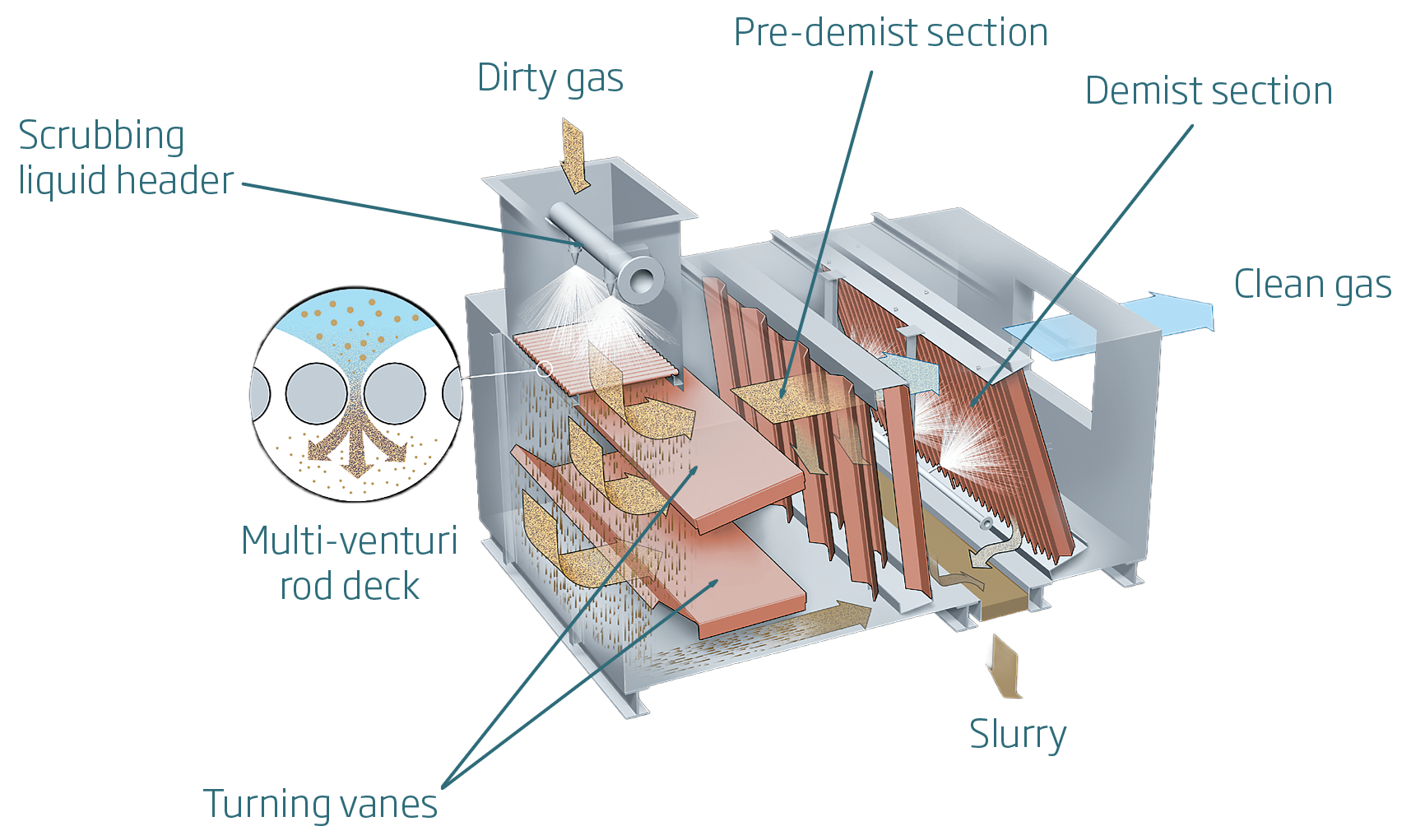
This design uses a venturi-rod deck — a series of rods that create a venturi effect between each rod — for higher efficiencies at lower pressure drops and liquid-to-gas ratios than conventional venturi scrubbers.
Atomized scrub water is sprayed co-currently through low-pressure, large-orifice nozzles across the deck. Gas accelerates through the rods, creating small droplets that encapsulate submicron particles. A two-stage demisting zone removes free water — the pre-demist area drops out 90% of the water and final demist vanes catch the rest — before dewatered gas exhausts via the outlet. The rod-deck design is easy to maintain.
Applications
Typical venturi scrubber applications
Mining
Ore processing & handling
Chemicals
Reagent gas cleaning
Food
Process emissions control
Metallurgy
Fume & particulate capture
Common things to know
Frequently Asked Questions
Answers to common questions about the FS flat bag filter
Loading component...
Loading component...
Loading component...
Loading component...
Loading component...
Talk to a Process Technology Expert Today
Connect with Nederman MikroPul to improve your dust collection.
Loading component...
Last updated: July 2026